
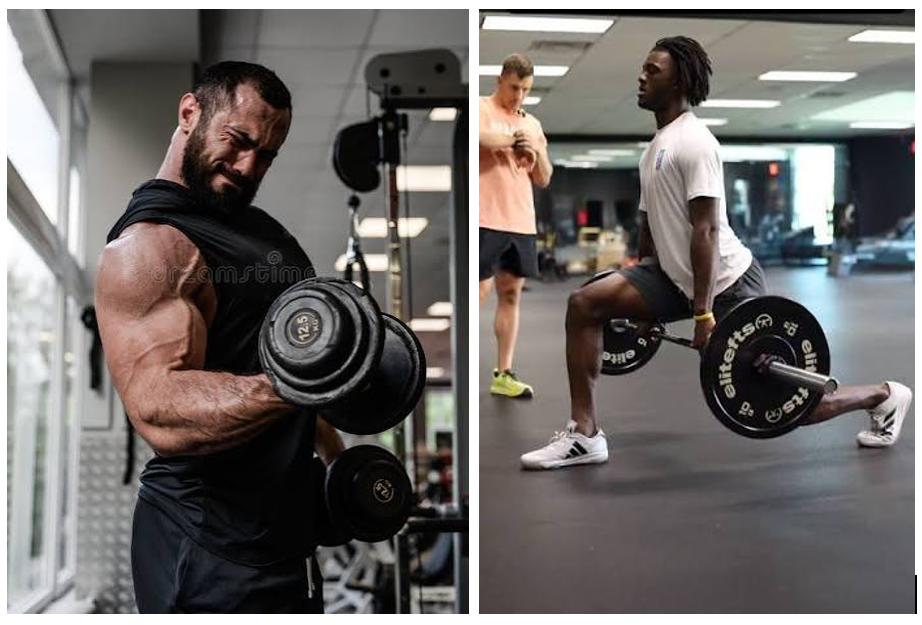
I’ve been seeing a disturbing trend among young athletes who want to do “Bro Lifts” with their buddies after seeing them on social media. I can tell you, after years in the business, that for an athlete who plays an explosive sport such as baseball, this usually does not end well.
Here are four reasons why.
Bro Lifts…
-
- Impede mobility by building “toxic hypertrophy,” or excess bulk and tightness
- Build “slow strength” rather than the “explosive strength” needed in baseball
- De-train the body’s ability to work together as a unified system through the kinematic chain
- Don’t account for fatigue management around bullpen and game schedules
Before we get into these bullet points, let me first say that you need to train for the task at hand…
If you want to be a bodybuilder, by all means, do bro lifts.
But as famed strength coach Mike Boyle once said, “If you want to be a model, go to modeling school.”
So, what exactly is a “Bro Lift”?
A “Bro Lift”, commonly known as a bro split or body-part split, is an approach to programming that has long been a staple in the competitive bodybuilding community. It dedicates each training day to a high volume of work for a single major muscle group.
Typical 5-Day Bro Split Structure – Instead of training the whole body or combining multiple muscle groups in one session, a classic five-day bro split typically breaks down the week like this:
-
- Monday: Chest Day
- Tuesday: Back Day
- Wednesday: Shoulder Day
- Thursday: Leg Day
- Friday: Arm Day, including biceps and triceps
- Saturday and Sunday: Rest or light cardio
The Cons
For a baseball pitcher, a traditional “bro split” is not just suboptimal. It can actually hinder performance and increase the risk of injury. Here’s are a few simple reasons why…
1. Impedes Mobility
Baseball requires an extreme and specialized range of motion in the shoulder, particularly for throwing and swinging.
The goal of a bro split is often high-volume muscle damage designed to force growth, or hypertrophy, and create “the pump.” Developing tight, bulky pecs or overly tight biceps can restrict the shoulder’s ability to lay back into external rotation during the late cocking phase of a throw. Restricting this range of motion can negatively affect both throwing and exit velocity.
Growth is good, as long as it is achieved in a way that does not sacrifice shoulder mobility.
2. Builds Slow Strength rather than Explosive Strength
Baseball relies heavily on the Stretch-Shortening Cycle (SSC), the ability of a muscle to rapidly stretch and then snap back, much like a rubber band, to generate explosive power.
Bro lifts typically focus on one or two muscle groups per day, often using partial ranges of motion to maintain “time under tension.” This can contribute to chronically tight, hypertonic muscles.
Both a pitcher’s throwing motion and a baseball swing require loose, fluid muscles that can rapidly tense at the appropriate moment. “Muscle-bound” players may develop poor hip-to-shoulder separation on the mound or a stiff, slow swing. They may also struggle to adjust to off-speed pitches because their muscles cannot relax and react as quickly.

“Muscle-bound” players often develop poor hip/shoulder separation on the mound because their muscles cannot relax and react quickly.”
3. De-Trains Using the Body Together
Athletes do not play sports one muscle at a time. They move using their whole body through the kinetic chain. Athleticism relies on the body working as a single, coordinated system. A throw starts at the feet, moves through the legs, transfers through the core, and ultimately exits through the hand.
Pitching is a high-velocity, full-body explosive movement. A bro split trains the body to operate in isolation, such as training chest on Monday and arms on Friday. An Upper/Lower split, on the other hand, trains the body to work as a unified system while still prioritizing the unique recovery needs of an overhead athlete.
In baseball, isolated muscles are inefficient muscles. When it comes to the lower body, if your quads are incredibly strong from leg extensions but your glutes and core do not know how to fire together to transfer that force into a sprint or a throw, that extra muscle mass can become heavy “dead weight” that slows you down.
“Isolated muscles are inefficient muscles that just becomes heavy “dead weight” that slows you down.”
4. Doesn’t Incorporate Fatigue Management
Bro lifts do not leave long enough windows of total upper-body rest to properly sync heavy lifting with a throwing or hitting schedule. If you have an intense “Arm Day” on Friday and a “Shoulder Day” on Wednesday, your upper-extremity joints and rotator cuff can remain constantly fatigued.
Attempting to throw a bullpen or get cage reps with a tight, fatigued upper body can alter mechanics and increase the risk of injury.
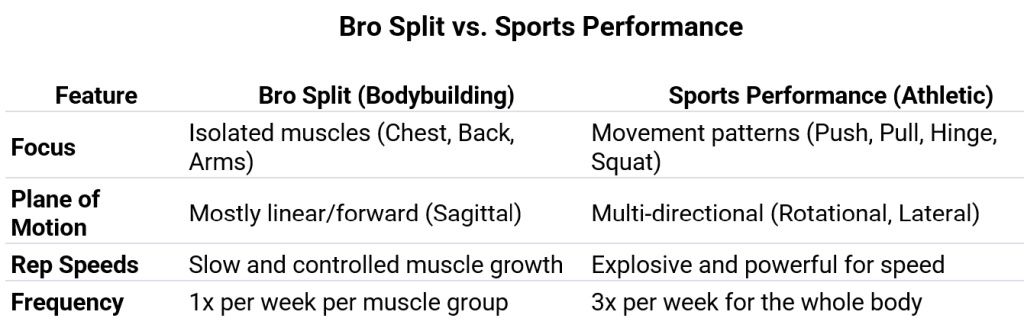
A five-day program that still includes high training volume, while working the upper body, lower body, and core twice per week and giving athletes a dedicated movement day, is the approach I use and the way many respected athletic performance coaches train their athletes. It allows for plenty of volume without cramming it all into one day each week.
Summary
Bro splits build “hood ornaments,” muscles that may look good but can slow you down and limit mobility. Sports performance training builds the “engine” by improving your power-to-weight ratio, preserving natural mobility, and helping you become a faster, more explosive, and more durable athlete.
See ya’ in the gym….
By Nunzio Signore